


CDI Best Practices: What Separates High-Performing Programs
Most CDI programs were built around a clear mandate: capture complications and comorbidities, shift DRG assignment, and demonstrate a return on investment through straightforward financial metrics. While that model worked well when fee-for-service dominated and payer scrutiny was comparatively limited, the programs leading their health systems today have evolved well beyond that starting point.
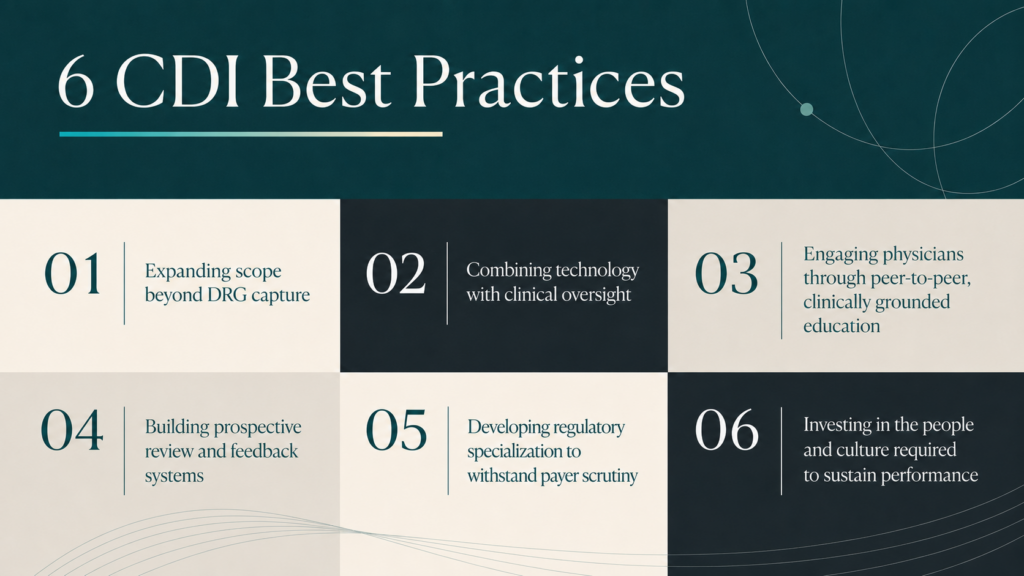
Six CDI best practices consistently separate high-performing departments from the rest:
- Expanding scope beyond DRG capture to include quality outcomes, risk adjustment, medical necessity, and denial prevention
- Combining technology with clinical oversight rather than substituting one for the other
- Engaging physicians through peer-to-peer, clinically grounded education
- Building review and feedback systems that operate prospectively
- Developing regulatory specialization to withstand payer scrutiny
- Investing in the people and culture required to sustain performance
All six are grounded in industry research and Enjoin’s experience partnering with leading health systems.
CDI Best Practices at a Glance
| Best Practice | Primary Goal | Key Metrics to Track |
| Expand scope beyond DRG capture | Quality outcomes, mortality accuracy, public rankings | Mortality index (O/E ratio), LOS index, SOI, ROM |
| Balance technology with clinical judgment | Defensible, accurate documentation at scale | Denial rate, denial overturn rate, coding accuracy |
| Build physician engagement | Documentation accuracy, lasting behavioral change | Query rate, Query response rate, physician agree rate |
| Implement prospective review and feedback | Continuous, measurable improvement | CMI, DNFB, coding accuracy rate, denial rate |
| Develop regulatory specialization | Audit readiness and payer defense | Appeals success rate, denied claim volume |
| Invest in staff development and retention | Operational stability and long-term scalability | Retention rate, query rate, productivity benchmarks |
1. Expand CDI’s Scope Beyond Reimbursement
CDI programs that measure success only through DRG shifts are leaving significant value on the table. As value-based payment models expand, organizations that earn sustained executive investment are those that can show CDI’s impact across quality performance, public reporting, and risk adjustment.
Leading programs now track a broader range of indicators, including mortality index, length of stay, severity of illness, risk of mortality, Patient Safety Indicators, hospital-acquired conditions, and risk adjustment measures such as HCC capture and RAF. This broader lens positions CDI as a mid-revenue cycle function, expanding its relevance beyond HIM and coding to quality, service line, and finance leaders.
At Memorial Sloan Kettering Cancer Center, CDI manager Chinwe Anyika reports on LOS index, mortality index, ROM, and SOI as primary program indicators, using those metrics to guide intensive reviews for a high-complexity patient population. At Brigham and Women’s Hospital, CDI director Deb Jones frames it this way: “We can say that the work we’re doing improved the expected mortality and in turn will improve our O/E that will then increase our ranking.”[1]
The key takeaway? Quality outcomes and financial accuracy are not competing objectives.
| Traditional CDI Focus | Next-Generation CDI Scope |
| DRG shift and CC/MCC capture | Mortality index, SOI, ROM, LOS index, PSIs |
| Financial ROI only | Financial and quality ROI |
| HIM and coding stakeholders | CFO, VP Rev Cycle, CQO, CMO, quality, and service line leadership |
| Retrospective documentation review | Concurrent and prospective improvement |
2. Balance Technology with Human Clinical Judgment
CDI technology investment has accelerated significantly across the industry, and outcomes have been mixed. More automation does not produce better results by default. What separates high-performing programs is how technology is deployed: as a support layer for clinical judgment, not a substitute for it.
The ACDIS Best Practices Guide identifies alert fatigue as a measurable consequence of over-automated approaches: “If you implement a technology that is going to catch any and every clinical abnormality on a patient record, there may be flags for clinically irrelevant conditions, and constant interruption may occur.” Dr. Christopher Petrilli, medical director of CDI at NYU Langone Health, puts the ceiling plainly: “No current technological solution comes anywhere close to replacing what a CDI specialist offers.”[1]
Health systems are increasingly prioritizing solutions that provide transparency, clinical governance, and defensible documentation guidance. Technology that surfaces opportunities without physician validation creates compliance risk; the combination of automation and clinical review produces findings that hold up under audit scrutiny.
| Where Technology Adds Value | Where Clinical Judgment Is Required |
| Case prioritization and queue management | Complex case validation |
| Pattern recognition across large discharge volumes | Defensible audit and appeal responses |
| Workflow scaling and operational reporting | Documentation specificity and clinical nuance |
| Identifying potential documentation gaps | Determining clinical significance and actionability |
3. Build Physician Engagement Through Clinically Relevant Education
Physician engagement is consistently cited as one of the most significant factors in CDI program performance, and one of the clearest differentiators between programs that improve and those that plateau. According to the 2025 ACDIS CDI Week Industry Survey, 57.12% of CDI programs report that providers are only “somewhat engaged,” meaning they understand CDI concepts but apply them inconsistently.[2]
Programs that close that gap share a common approach: they frame documentation improvement in clinical terms. The ACDIS Best Practices Guide notes that physicians respond much better when approached through the lens of quality outcomes than when engaged around reimbursement alone.[1] Peer-to-peer communication, specialty-specific education, and connecting documentation to patient outcomes produce more durable behavioral change than query volume alone.
The ACDIS survey found that 71.22% of CDI programs now use a physician advisor, the highest rate recorded since tracking began; programs with a physician advisor are also significantly more likely to have a physician champion, reinforcing that clinical peer credibility multiplies across the organization.[2]
| Standard Training Approach | Physician-Directed, Peer-to-Peer Model |
| Compliance-framed messaging | Quality outcomes and patient care framing |
| CDI specialist to physician queries | Physician advisor to physician dialogue |
| Generic documentation guidance | Specialty-specific clinical scenarios |
| Infrequent or as-needed sessions | Continuous feedback tied to performance data |
4. Implement a Robust Review and Feedback System
Sustainable CDI performance requires more than retrospective auditing. High-performing programs use prospective review models that identify documentation gaps before claims are submitted, closing the window on missed opportunities rather than chasing them after the fact.
Effective review systems combine CDI expertise, coding knowledge, physician oversight, and analytics across the full discharge cycle: concurrent review during admission, post-discharge validation, and pre-bill confirmation of DRG accuracy, coding alignment, and documentation completeness. That layered structure reduces downstream denial exposure and supports more defensible coding from the start.
Individual-level performance data matters as well. Giving CDI specialists visibility into their own query impact, beyond aggregate program metrics, creates accountability and enables meaningful benchmarking. At Brigham and Women’s Hospital, each CDI specialist carries a goal of a 35% query rate for severity and quality-type queries; that level of specificity is what separates programs that improve incrementally from those that improve deliberately.[1]
| Review System Element | Why It Matters |
| Prospective, pre-bill review | Closes documentation gaps before claim submission |
| Multidisciplinary oversight | Reduces errors across CDI, coding, and clinical teams |
| Individual-level performance data | Drives accountability and specialist development |
| Real-time analytics and reporting | Enables continuous, data-driven improvement |
5. Develop Regulatory Specialization
Payer scrutiny is accelerating at a pace most in-house CDI teams are not resourced to match. According to the MDaudit 2024 Benchmark Report, clinical documentation audits doubled year-over-year in 2024, contributing to a 51% increase in clinical denials over three years.[3] The downstream effect is reflected in program data: clinical validation denials are now reviewed by 87.73% of CDI programs, and DRG validation denials under review rose from 54.66% to 64.11% in a single year.[2]
Organizations that perform well under audit scrutiny build dedicated regulatory expertise: teams that monitor payer trends, structure concurrent reviews with defensibility in mind, and manage appeals through physician-led clinical arguments rather than generic templates. A reactive posture, responding to denials after the fact, consistently results in avoidable financial exposure with limited recourse.
The most frequently denied diagnoses, including sepsis, respiratory failure, and encephalopathy, share a common thread: documentation that meets clinical standards often does not satisfy payer validation criteria.[2] Closing that gap requires specialists with dedicated expertise in both clinical documentation and denial defense, including the capacity to respond at every stage of the audit process.
| Reactive Compliance Posture | Proactive Regulatory Specialization |
| Responds to denials after submission | Designs documentation with defensibility in mind |
| Generic appeal arguments | Physician-led, clinically grounded appeal language |
| Monitors policy changes after the fact | Tracks payer trends and regulatory updates in advance |
| Financial impact absorbed post-denial | Revenue protected at the pre-bill stage |
6. Invest in Staff Development and Retention
CDI and coding workforce shortages have intensified across the industry. Programs that treat staffing primarily as a recruitment challenge often find that turnover continues regardless of hiring volume. The programs that sustain performance invest in retention: professional development, meaningful feedback, clear career pathways, and a culture that recognizes CDI professionals as strategic contributors.
The ACDIS Best Practices Guide is direct on the cost of underappreciation: staff who feel undervalued show reduced productivity and quality before they leave, and that disengagement affects physician relationships and overall program performance.[1] Leaders who invest in continuous education, flexible workforce models, and consistent individual recognition build teams that perform and stay.
Physician-to-CDI staff relationships are part of this equation. Programs that help CDI specialists demonstrate their value to physicians, and that equip physician advisors to bridge the communication gap, reduce friction and strengthen the collaboration that effective documentation improvement depends on.
| Staff Development Investment Area | Impact on Program Performance |
| Continuous CDI and coding education | Improves query quality, accuracy, and defensibility |
| Professional development and career pathways | Reduces turnover and preserves institutional knowledge |
| Physician-CDI relationship building | Strengthens engagement and documentation responsiveness |
| Flexible workforce and advisory access | Extends team capacity without sacrificing quality oversight |
Enjoin: CDI Best Practices in Action
Implementing best practices for CDI programs at this level requires more than internal commitment; it requires a partner with the clinical depth, operational infrastructure, and track record to make each one work. Enjoin was built to address the CDI program success factors that matter most:
- Quality-Driven Documentation Review: Enjoin’s physician-directed approach aligns documentation improvement across clinical quality, reimbursement accuracy, and denial defensibility simultaneously, giving health systems a complete picture of CDI performance rather than a narrow financial view.
- Technology With Clinical Oversight: Our EnFORM+ platform applies deterministic clinical logic grounded in known DRG relationships and physician-validated pathways to identify and prioritize documentation opportunities. Physician and analyst teams determine what moves forward. Technology supports; physicians decide.
- Physician-Led Education and Advisory: Board-certified physicians deliver peer-to-peer education aligned to specialty-specific documentation challenges, with continuing education credits and feedback that connects directly to quality metrics and patient care outcomes.
- Pre-Bill Chart Review: Enjoin’s review process validates principal and secondary diagnosis accuracy, DRG assignment, coding accuracy, query opportunities, and payer compliance before billing, with real-time analytics providing visibility across all key program metrics.
- Denial Defense: When denials occur, Enjoin provides comprehensive Level 1 appeals, Level 2 escalated defense, and Administrative Law Judge (ALJ) hearing testimony, with physician-led clinical arguments grounded in the same standards payers apply during audit.
- Mid-Revenue Cycle Staffing: Enjoin gives health systems access to experienced CDI specialists, inpatient coders, outpatient documentation experts, and physician leadership resources that support both immediate capacity needs and long-term team development.
With four decades of clinical experience, $2B+ in revenue recovery, a 900% average return on investment, and a denial rate below 2% on reviewed cases, Enjoin’s record reflects what high-performing CDI programs are built to do.
Last updated: July 8, 2026
Sources
[1] ACDIS. Best Practices Guide: Creating the Next Generation CDI Department. Sponsored by Nuance Communications, April 2022. https://acdis.org/resources/best-practices-guide-creating-next-generation-cdi-department
[2] ACDIS. 2025 CDI Week Industry Overview Survey. HCPro, 2025. https://acdis.org/sites/acdis/files/cdi-week/Industry-Report-CDI-Week-2025.pdf
[3] MDaudit. 2024 Benchmark Report. MDaudit, November 2024. https://mdaudit.com/resource/press-release/mdaudits-2024-benchmark-report-reveals-a-fivefold-increase-in-dollars-at-risk-from-payer-audits-while-coding-related-denials-surged-by-over-125/