


How EnFORM+ Works
A Guide to Implementation, Scalability, and Defensible Revenue Impact
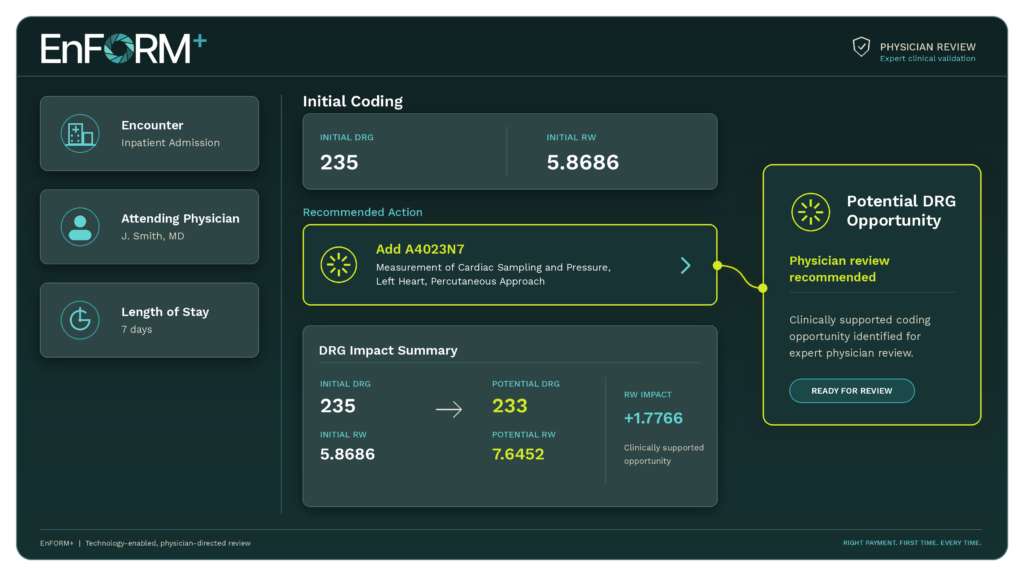
EnFORM+ is Enjoin’s proprietary clinical intelligence and prioritization technology. It is designed to expand the reach of inpatient review without removing clinical judgment from the process. The platform analyzes 100% of eligible inpatient discharges, identifies and ranks potential documentation, coding, and DRG opportunities, and directs the highest-priority charts to Enjoin’s clinical coding analysts and physicians for comprehensive validation.
For a CFO, the practical question is not whether a technology can generate alerts. It is whether the operating model can reliably convert large-scale analysis into accurate, compliant, measurable, and defensible action. EnFORM+ was built around that distinction.
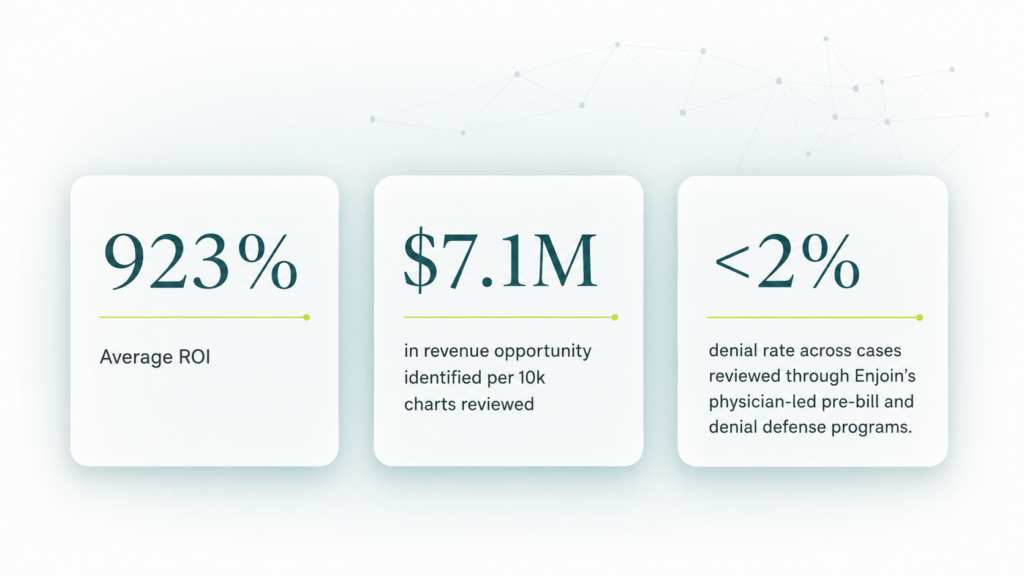
The core idea: scale the reach of experts, not replace them
Traditional chart review is constrained by time. Even highly experienced teams can review only a fraction of an inpatient population, particularly when coding turnaround times are tight and internal CDI resources are already focused on concurrent workflows. EnFORM+ changes the coverage model by using technology to screen the eligible population and surface opportunities within cases for deeper, clinical review.
The technology does not make the final clinical determination. It creates a structured, prioritized starting point to go wide across all eligible discharges and deep within each case. Enjoin’s reviewers then examine the complete patient record, validate the clinical and coding logic, consider incidental findings, and determine whether a recommendation should move forward.
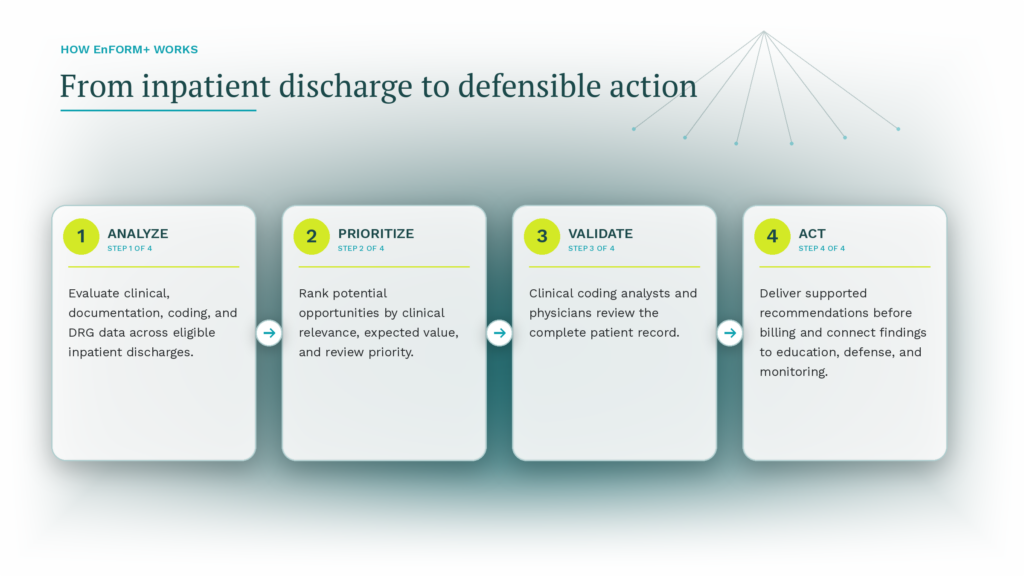
1. Analyze the eligible inpatient population
EnFORM+ ingests and evaluates the account data needed to assess inpatient encounters. Rather than relying only on a narrow focus list or a predefined sample, the platform is designed to analyze 100% of eligible inpatient discharges within the agreed scope. This creates broader visibility into the population and reduces the risk that valuable or high-risk cases remain outside the review queue.
2. Apply deterministic clinical and DRG logic
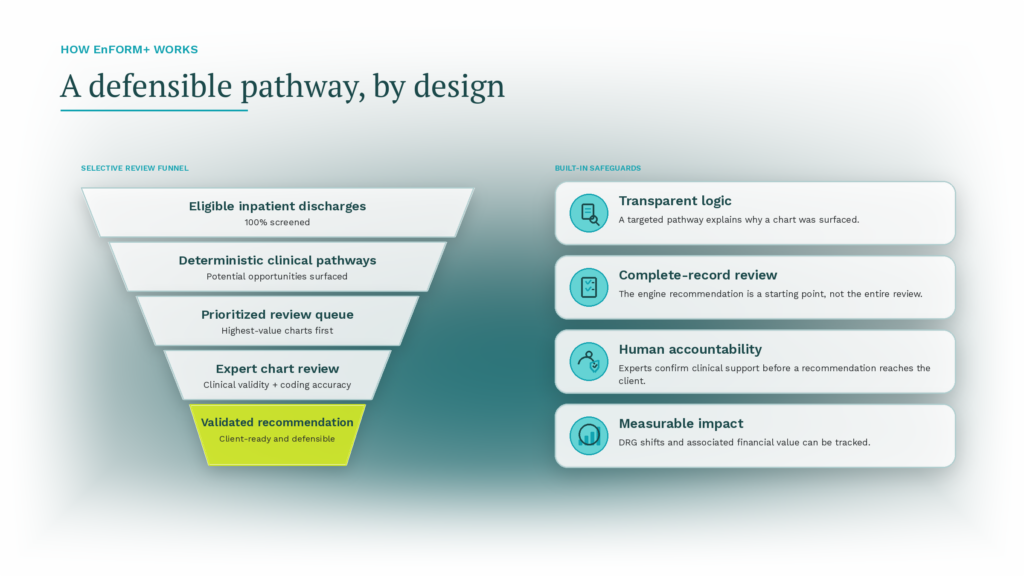
EnFORM+ uses clinically informed pathways derived from Enjoin’s 40 years of physician-led chart-review experience. The platform examines relationships among the starting DRG, diagnoses, procedures, code combinations, and available clinical information to identify potential opportunities for resequencing, respecification, CC/MCC capture, and other DRG-related changes. The logic is targeted and explainable: a case is surfaced because it followed a defined clinical and coding pathway, not because a black-box model produced an unexplained score.
3. Prioritize Accounts With Highest Propensity for Change
Screening every eligible discharge is only useful if the resulting work can be operationalized. EnFORM+ ranks and organizes opportunities so expert reviewers can focus first on the accounts most likely to benefit from review. This bridges population-scale analysis with finite human review capacity.
4. Assign each chart to the right reviewer
Different cases require different forms of expertise. The platform supports a workflow in which prioritized cases are assigned to the person best equipped to evaluate them. Clinical coding analysts review the flagged opportunity, assess the coding and documentation, and escalate or route cases for physician validation as appropriate.
5. Perform a complete, 360-degree chart review
The engine’s recommendation is a starting point, not the boundary of the review. Enjoin reviewers evaluate the complete patient record and look for findings beyond the initial pathway. This matters because the clinically correct and financially appropriate outcome may differ from the first signal. A comprehensive review helps ensure the final recommendation reflects the full clinical story rather than an isolated data point.
6. Validate clinical support, coding accuracy, and defensibility
Before a recommendation reaches the health system, Enjoin’s clinical experts determine whether the opportunity is supported by the documentation, consistent with coding guidance, clinically accurate, and sufficiently defensible under payer scrutiny. The goal is not to maximize recommendation volume. The goal is to deliver recommendations that a health system can act on with confidence.
7. Quantify the result and create a learning loop
Because the workflow is grounded in DRG infrastructure, EnFORM+ can connect an accepted recommendation to a DRG shift and the associated financial impact. Findings can also reveal recurring documentation, coding, service-line, or provider trends. Those patterns can inform targeted education (link), denial-prevention efforts (link), and ongoing performance monitoring.
What information does EnFORM+ need?
EnFORM+ is configured to align with each organization’s patient population, payer mix, workflows, and technology environment. Depending on the scope of the engagement, it securely uses relevant clinical, coding, financial, and encounter information to identify and prioritize potential revenue integrity opportunities.
Specific data and integration requirements are determined during implementation based on the health system’s unique needs:
- Clinical information
- Coding and encounter data
- Relevant financial information
- Secure access necessary for expert review
How implementation works
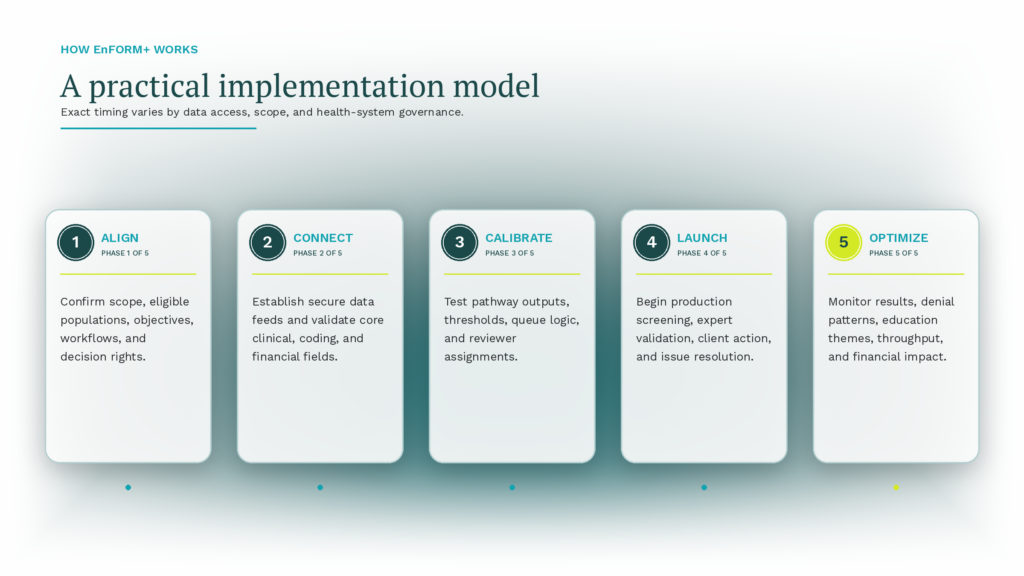
Implementation is designed to be straightforward for the health system. Enjoin manages EnFORM+ within its own workflow, so client teams are not required to learn or operate new technology. The focus is on aligning scope, data access, turnaround expectations, escalation paths, and success measures so Enjoin can begin delivering results with minimal disruption to existing operations.
Alignment and governance
The teams define the eligible population, payer and facility scope, review objectives, performance measures, decision rights, and the clinical and financial stakeholders who will govern the program.
Data connection and validation
Technical teams establish secure data transfer, confirm required fields, test completeness and timeliness, and reconcile key encounter, coding, and financial values.
Workflow calibration
Before full production, the teams validate that cases are entering the correct queues, reviewers can access the chart, outputs are understandable, and recommendations can be acted upon within the billing workflow.
Production launch
EnFORM+ begins screening the agreed inpatient population. Prioritized cases flow to expert review, validated recommendations are delivered, and exceptions are managed through a defined process.
Performance optimization
The teams monitor volume, review yield, turnaround, accepted recommendations, DRG impact, denial outcomes, education themes, and operational bottlenecks. Thresholds and workflows can be refined as the health system’s needs evolve.
Why the model is scalable
Population-wide coverage
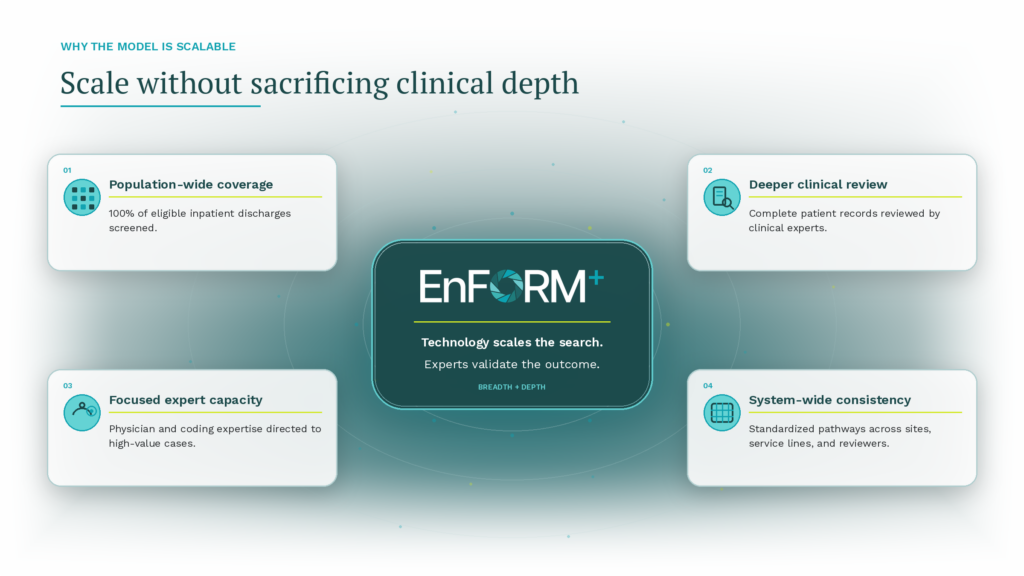
Technology enables consistent review across the eligible inpatient population, reducing dependence on manual sampling, narrow DRG lists, or a reviewer’s ability to search for opportunity one chart at a time. This allows the model to go wide and consider more cases than a manual process alone could reasonably reach.
Deeper clinical review
Broad screening is only the first step. Once a chart is prioritized, expert reviewers go deep into the patient record to understand the full clinical story—not just the individual signal that caused the case to surface. That includes reviewing documentation, clinical indicators, treatments, coding relationships, and the broader context needed to determine whether a recommendation is accurate and defensible.
Better use of expert capacity
Prioritization helps ensure scarce physician and coding expertise is focused on the cases where deeper review has the greatest potential value. Technology narrows the field; experts determine what the complete record actually supports.
Standardization across the health system
Defined clinical pathways and review protocols support greater consistency across hospitals, service lines, reviewers, and time periods. This makes it possible to scale the process while maintaining a common standard for clinical validation, coding accuracy, and recommendation quality.
Flexible expansion
Once data quality, workflows, and governance are established, the operating model can expand to additional facilities, payer populations, or use cases without rebuilding the process from the ground up. The same wide-and-deep approach can be applied across a larger and more complex health system.
Continuous improvement
The value does not end with an individual chart. Findings can reveal recurring documentation gaps, coding patterns, service-line trends, and denial risks. Those insights can be used to refine education, strengthen denial prevention, improve workflows, and make future prioritization even more precise.
That is what meaningful scalability looks like.
Broader population coverage, deeper clinical understanding, and expert attention focused where it matters most.
How EnFORM+ differs from an AI-only approach
An AI alert-only model can create the appearance of scale while shifting the burden of validation back to the health system. If internal teams must investigate large volumes of low-confidence findings, the technology may add work instead of reducing it. EnFORM+ is designed as part of an end-to-end review model: technology identifies and prioritizes; clinical coding analysts and physicians validate; the health system receives a supported recommendation; and outcomes feed education, denial defense, and performance improvement.
| Question | Alert-only model | EnFORM+ operating model |
| Who validates the finding? | Often the health system | Enjoin clinical coding analysts and physicians |
| What is reviewed? | The isolated alert or targeted condition | The complete patient record, including incidental findings |
| How is work prioritized? | Alert volume or model score | Clinical pathways, expected relevance, and review priority |
| What reaches the client? | A potential opportunity | A clinically and coding-validated recommendation |
| How is value measured? | Alert counts or estimated lift | Accepted recommendations, DRG impact, financial results, and downstream outcomes |
Evidence that clinical validation changes the result
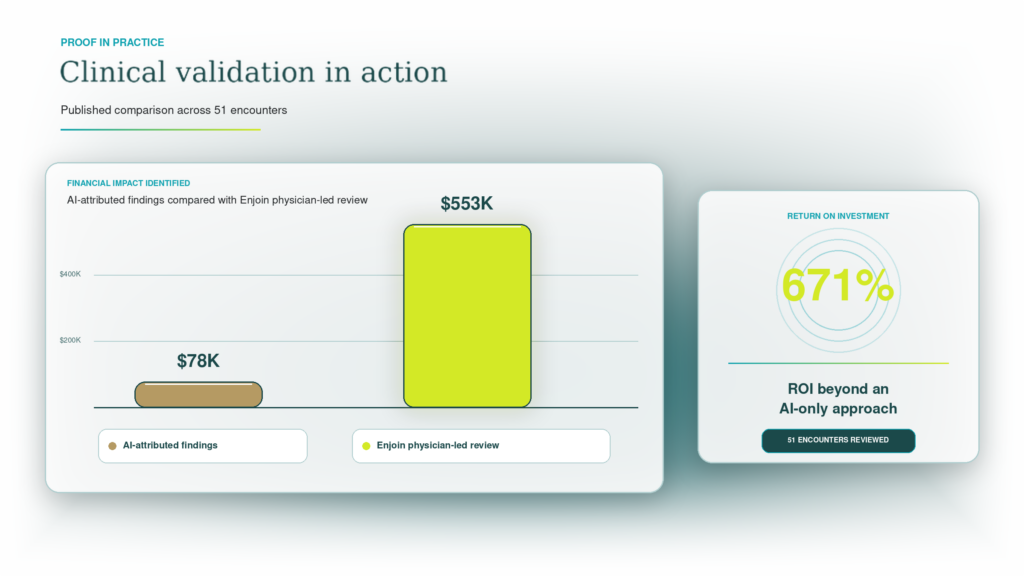
In a published comparison across 51 encounters, Enjoin’s physician-led review identified approximately $553,000 in revenue opportunity compared with $78,000 originally attributed to AI-generated findings. More than half of the AI alerts fell within DRG families Enjoin physicians had already identified. The reported result was 671% ROI beyond an AI-only approach. This example should not be interpreted as a universal guarantee; results vary by case mix, baseline processes, data quality, scope, and implementation. It does illustrate why alert volume alone is an incomplete measure of technology value.
What a CFO should expect to measure
- Eligible discharges screened and percentage successfully processed
- Number and value of prioritized cases sent for expert review
- Review yield and recommendation acceptance
- Incremental revenue by facility, payer, service line, and opportunity type
- Average value per accepted recommendation or DRG optimization
- Turnaround time from discharge to recommendation and client action
- Denial rate and payer response on reviewed claims
- Education themes and recurrence of documentation or coding gaps
- Internal labor avoided or expert capacity redirected
- Net ROI after technology, review, and operational costs
The strongest governance model separates leading indicators from realized financial outcomes. Screening volume and flagged opportunities show whether the workflow is functioning. Accepted recommendations, final-billed DRGs, collections, denial experience, and net financial impact show whether it is creating durable value.
Questions to ask during evaluation
- Can the vendor explain why each case was surfaced?
- Does the workflow analyze the eligible population or only a subset of preselected DRGs?
- Who reviews the full medical record before a recommendation is delivered?
- How are coding guidance, clinical criteria, payer scrutiny, and compliance incorporated?
- How are cases prioritized and assigned to reviewers?
- What data is required, and how is data quality validated?
- How are recommendations integrated into the pre-bill workflow?
- Can the vendor connect accepted recommendations to final financial outcomes?
- What implementation resources are required from IT, CDI, coding, finance, and compliance?
- How does the model support education, denial defense, and sustained performance improvement?
The bottom line
EnFORM+ is not designed to replace the people who understand the patient, the clinical record, and the complexities of coding—nor is it intended to diminish the value of other technologies. Its purpose is to overcome the limitations of reviewing patient populations at scale, enabling Enjoin’s clinical and coding experts to focus on the cases where their expertise can have the greatest impact. This is how Enjoin delivers its comprehensive, 360-degree service model with greater speed, precision, and scale.
The approach is straightforward: analyze broadly, prioritize intelligently, validate clinically, act before billing, and measure the results. For CFOs, this reframes the technology conversation—from how many alerts a solution generates to whether the health system can consistently produce accurate, defensible claims and measurable financial value at scale.