


What Is Clinical Documentation Integrity (CDI)? A Strategic Executive Guide for Health Systems
Clinical documentation serves as the definitive legal and clinical account of a patient’s encounter. For executive leadership across health systems, the documentation within an Electronic Health Record (EHR) represents far more than an administrative record—it is the direct translation of patient severity, clinical decision-making, and resource consumption into coded data.
When clinical documentation lacks precision, the structural gap between care delivered and care represented expands. The consequences are immediate and severe: clinical validation denials spike, Risk-Adjusted Mortality and Quality metrics degrade, and Medicare Advantage or commercial payer audits challenge facility case mix.
According to standards set by the American Health Information Management Association (AHIMA) and the Healthcare Financial Management Association (HFMA), establishing enterprise clinical documentation integrity is no longer just about generating queries—it is about clinical defensibility and sustainable revenue cycle performance.
In this strategic guide, we examine:
- The elevated clinical documentation integrity definition endorsed by AHIMA and industry leaders.
- What a modern CDI program looks like through the integration of artificial intelligence (AI) and advanced health informatics.
- How Enjoin’s EnFORM+ pre-bill technology unites AI scalability with physician-led clinical expertise.
- The “hidden costs” of unfiltered CDI technology, including non-viable query volume and provider query fatigue highlighted by HFMA insights.
- The severe liabilities—to health systems, physicians, and patients—of ungoverned AI, clinically invalid diagnoses, and hallucinated discharge summaries.
- Balanced review timelines aligned with HFMA pre-bill metrics and modern executive/quality KPIs.
Defining Clinical Documentation Integrity in Modern Healthcare
To establish an authoritative program, health system executives must clearly delineate what is CDI in healthcare today compared to legacy, manual frameworks.
Comprehensive Clinical Documentation Integrity Definition
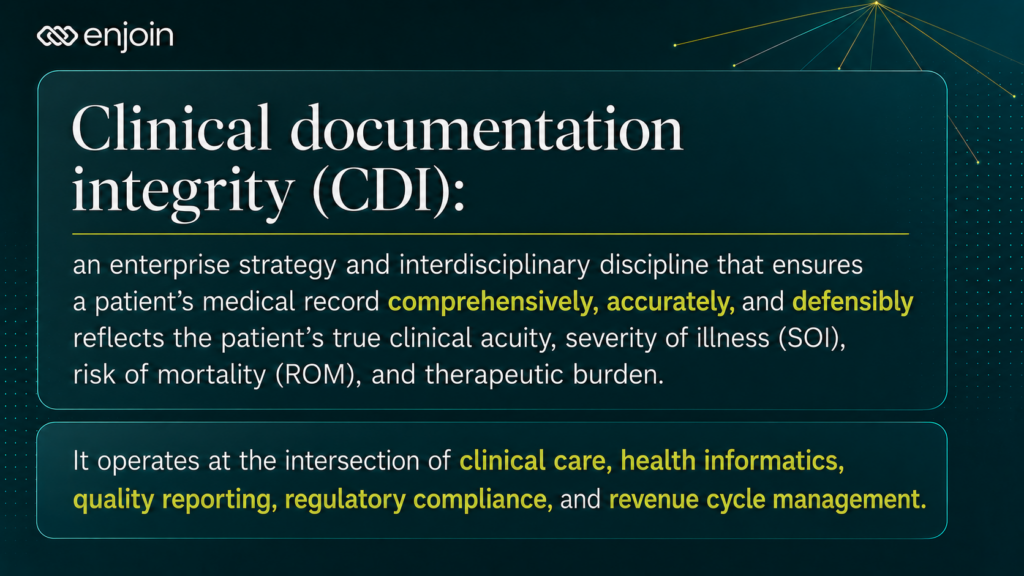
Clinical documentation integrity (CDI) is an enterprise strategy and interdisciplinary discipline that ensures a patient’s medical record comprehensively, accurately, and defensibly reflects the patient’s true clinical acuity, severity of illness (SOI), risk of mortality (ROM), and therapeutic burden. It operates at the intersection of clinical care, health informatics, quality reporting, regulatory compliance, and revenue cycle management.
Integrity vs. Improvement: An AHIMA & HFMA Distinction
While industry literature frequently uses clinical documentation improvement and clinical documentation integrity interchangeably, executive leaders must distinguish between the two:
- Clinical Documentation Improvement (Legacy Focus): Historically centered on process-oriented, manual query workflows aimed primarily at capturing missing secondary diagnoses (CCs/MCCs) to optimize immediate financial DRG assignment.
- Clinical Documentation Integrity (Modern Standard): As defined in AHIMA practice briefs, true integrity encompasses clinical validation, quality outcome defense, regulatory compliance, and clinical credibility. It ensures that every documented condition is supported by objective clinical criteria accepted by the medical community, capable of withstanding post-payment payer audits, OIG reviews, and peer-to-peer medical director scrutiny.
Focusing solely on “improvement” without clinical validation integrity exposes health systems to massive takeback demands and audit clawbacks when payers perform retrospective clinical validation denials.
What a “Modern” CDI Program Looks Looks Like: The Tech-Enabled Ecosystem
Legacy CDI programs relied on manual chart reviews, where specialists hand-screened a fraction of patient records. A modern CDI program transforms this model into an automated, data-driven framework powered by advanced pre-bill review platforms like Enjoin’s EnFORM+.
Why Both Technological Scalability and Clinical Expertise Are Critical
HFMA analysis emphasizes that while AI can accelerate case processing, it cannot replace clinical reasoning. Modern programs require a symbiotic balance:
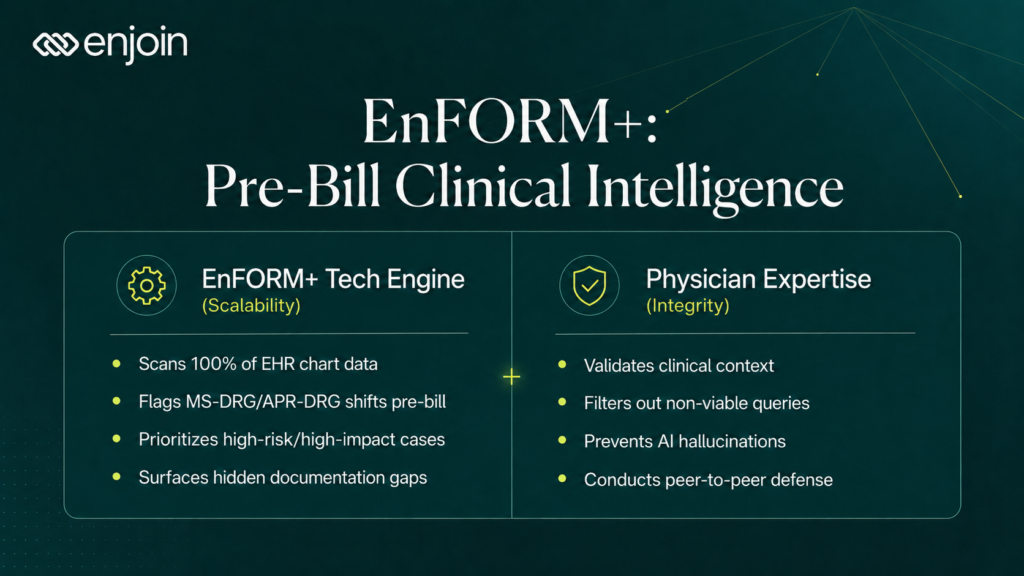
- Why Technology Scalability Is Critical: Modern health systems process thousands of patient encounters daily. Without technology like EnFORM+, CDI teams miss high-complexity cases hidden within massive EHR chart volumes. Technology provides the speed, reach, and precision triage required for enterprise scalability.
- Why Human Clinical Expertise Is Critical: As highlighted in HFMA guidance, AI tools operate on statistical probabilities rather than clinical judgment. Algorithms cannot analyze a nuanced clinical trajectory, interpret provider intent, or defend care severity against payer medical directors. Human specialists and board-certified physicians provide the clinical judgment, compliance verification, and ethical oversight necessary to confirm that a diagnosis is clinically valid and defensible.
Enterprise Program Architecture & Roles
An effective CDI program functions as a cohesive clinical-coding-quality risk-mitigation framework supported by health informatics.
| Role | Core Strategic Function | Modern Technology Integration | Clinical & Quality Value |
| CDI Specialist (CDIS) | Conducts deep clinical chart analysis; identifies clinical gaps and diagnostic ambiguity. | At Enjoin, uses EnFORM+ prioritization queues to focus on high-yield, complex charts rather than manual scanning. | Initiates compliant, non-leading queries grounded in official AHIMA/ACDIS practice briefs. |
| Medical Coder / Inpatient Auditor | Translates validated clinical documentation into official ICD-10-CM/PCS codes and MS/APR-DRGs. | Leverages computer-assisted coding (CAC) cross-referenced with pre-bill clinical insights. | Eliminates discrepancies between clinical intent and billed claims prior to submission. |
| Quality Analyst | Evaluates documentation impact on clinical outcomes, severity ratings, and risk adjustment. | Utilizes analytics tools to track Present on Admission (POA) flags, eCQMs, and PSI/HAC risks in real time. | Protects hospital star ratings, prevents unmerited PSIs/HACs, and guards quality rankings. |
| Physician Advisor (PA) | Conducts complex clinical validation, executes provider engagement, and leads denial appeals. | Reviews tech-highlighted clinical discrepancies to resolve ambiguous medical cases. | Provides clinical insight gained over years of practicing medicine to ensure the coded claim accurately reflects the clinical reality of the patient” |
The “Hidden Costs” of Technology: Algorithmic Noise & Query Fatigue
While generic software vendors often market automated CDI tools as standalone solutions, HFMA research cautions that introducing technology without clinical oversight creates severe operational drag.
1. The Flood of Non-Viable AI Queries
Off-the-shelf NLP engines and generative AI tools frequently perform simple keyword matching or flag isolated laboratory anomalies (e.g., a single elevated creatinine level or isolated low sodium). These platforms lift huge volumes of potential “opportunities” to CDI staff that, upon human review, are found to be clinically non-viable.
2. Wasted Administrative Hours & Reduced Productivity
When CDI staff must manually review hundreds of AI-generated false positives daily, productivity plummets. Instead of spending time on complex clinical validation or provider education, specialists become “algorithmic noise filters” sorting through low-yield automated alerts.
3. Physician “Query Fatigue”
If automated or semi-automated systems are allowed to trigger queries directly to physicians without human vetting, providers are bombarded with irrelevant prompts. As noted by HFMA, this leads to query fatigue, degraded physician engagement, and mistrust toward the health system’s documentation initiatives.
How EnFORM+ Solves the Noise Problem: Unlike standalone AI that floods workflows with false leads, EnFORM+ is designed to pair precision analytics with physician-directed review. Non-viable query suggestions are filtered out before reaching clinicians, preserving CDI productivity and eliminating physician query fatigue.
The Liabilities of Ungoverned AI: Systems, Physicians, and Patients
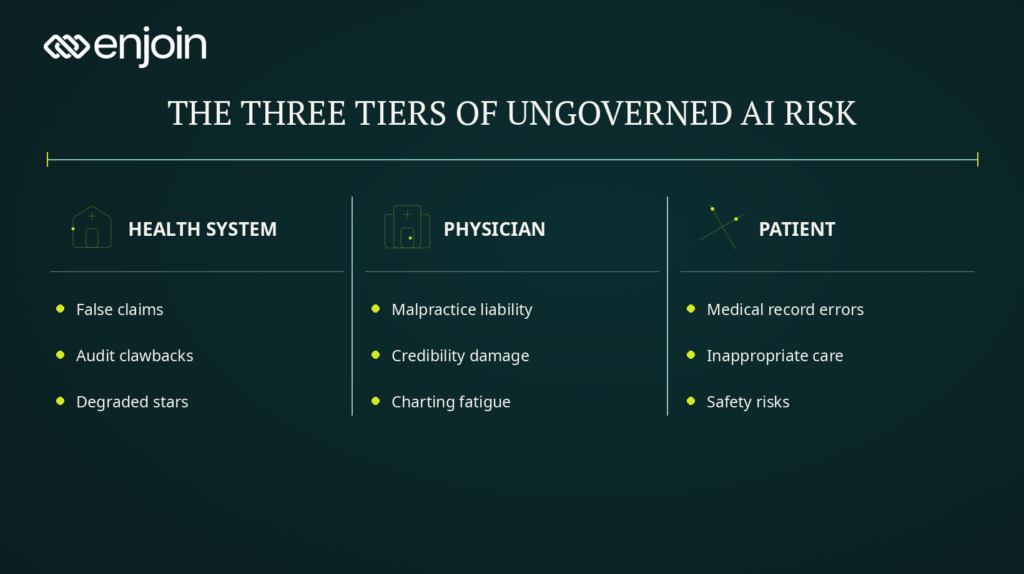
The most dangerous operational trap for a health system is removing human oversight in pursuit of automated “efficiency.” Deploying ungoverned AI suggestions or ambient documentation scribes without clinical verification creates enterprise liabilities across three distinct tiers:
1. Clinically Invalid Diagnoses
AHIMA practice briefs stress that every diagnosis must be substantiated by clinical evidence. AI tools regularly identify medical terms without understanding clinical criteria or treatment context. For example, an algorithm might suggest querying for “Acute Renal Failure” based on a temporary lab shift, even when the attending physician has clinically ruled it out. If an unvalidated diagnosis is added to the claim, payers will flag it during retrospective audits, resulting in audits, takeback demands, and potential False Claims Act liability.
2. Generative AI Hallucinations in Discharge Summaries
Ambient clinical tools and Large Language Models (LLMs) used to generate discharge notes or clinical summaries present a unique threat: AI hallucinations. Generative engines can invent non-existent clinical events, misstate medication dosages, omit critical surgical findings, or fabricate diagnoses out of thin air.
3. The Triple Liability Breakdown
A. Liability to the Health System
- Financial & Regulatory Exposure: Post-payment audit retractions, RAC audit penalties, and legal liability for billing codes unsupported by clinical criteria.
- Quality & Reputation Loss: Hallucinated diagnoses or missing POA flags corrupt Risk-Adjusted Mortality rates, leading to inaccurate public quality rankings and diminished CMS Star Ratings.
B. Liability to the Physician
- Legal & Malpractice Risk: Attending physicians remain legally responsible for everything in the medical record. Signing off on an AI-generated note or discharge summary containing hallucinations exposes the clinician to severe malpractice liability during legal proceedings.
- Professional Burden: Providers face administrative friction trying to correct automated errors in permanent medical records.
C. Liability to the Patient (Patient Safety Impact)
- Clinical Safety Hazards: A hallucinated allergy, incorrect medication history, or unvalidated chronic diagnosis added by an automated tool follows the patient across their entire healthcare journey.
- Downstream Care Decisions: Subsequent care teams rely on inaccurate discharge summaries, potentially leading to inappropriate diagnostic testing, adverse drug events, or dangerous treatment plans.
Rethinking Review Timing: The Pre-Bill Advantage with EnFORM+
A modern CDI program aligns technology with strategic review timing, recognizing that review stages should reinforce—not replace—one another.
- Concurrent Review (The Enterprise Preference): Preferred by most health systems because it enables real-time provider engagement while clinical context is fresh. CDI specialists interact with care teams during admission to address documentation gaps early.
- Pre-Bill Review with EnFORM+ (The Targeted Safety Net): Post-discharge and prior to final claim drop, EnFORM+ scans the complete finalized record. Aligning with HFMA pre-billing standards, it pinpoints uncaptured DRG shifts, missing secondary conditions, and clinical validation vulnerabilities before claims affect Discharge Not Final Billed (DNFB) metrics and reach payers.
- Retrospective Review (Governance & Provider Education): Focuses on system-wide trend analysis, auditing AI accuracy, and refining physician education programs.
Executive & Quality KPIs for the Digital Era
Evaluating a modern CDI program requires looking beyond vanity metrics like total query volume. Grounded in HFMA MAP Keys and AHIMA quality frameworks, executive dashboards must measure accuracy, efficiency, and safety:
Financial & Operational KPIs (HFMA Revenue Cycle Focus)
- EnFORM+ Query Precision & Viability Rate: Measures the percentage of tech-identified opportunities that yield compliant, clinically valid documentation updates.
- Discharged Not Final Billed (DNFB) Impact (HFMA PB-3): Tracks how pre-bill technology streamilnes review workflows to accelerate claim submission without sacrificing compliance.
- Clinical Validation Denial Rate: Tracks how often payers overturn claims for lack of clinical evidence. Low denial rates confirm strong pre-bill physician clinical validation.
- Acuity & Case Mix Alignment: Verifies that billed Severity of Illness (SOI) and Risk of Mortality (ROM) accurately reflect true patient severity.
Quality & Safety KPIs (AHIMA Framework Focus)
- PSI / HAC Accuracy & POA Compliance: Ensures Patient Safety Indicators and Hospital-Acquired Conditions are verified as clinically accurate and correctly tagged as Present on Admission.
- Risk-Adjusted Mortality Index: Measures the accuracy of secondary conditions in reflecting true therapeutic burden, protecting public hospital ratings.
- Value-Based Care Performance: Evaluates documentation precision under eCQMs, alternative payment models, and CMS Star Ratings.
Enterprise Execution: Partnering for Sustainable Integrity
Building a high-performing CDI infrastructure requires balancing advanced analytics, human clinical judgment, and quality-driven provider engagement. Technology provides the scale, but physician leadership provides the defensibility.
Enjoin has championed this physician-directed model for over 37 years. Through EnFORM+, Enjoin provides advanced clinical intelligence that empowers health systems to scale pre-bill chart reviews, pinpoint hidden revenue opportunities, eliminate AI noise, and protect against audit clawbacks—all backed by U.S. board-certified physicians and strict AHIMA/ACDIS compliant query guidelines.
By unifying physician leadership with EnFORM+, Enjoin helps health systems move past basic query volume to build clinically defensible, modern documentation programs that protect revenue, satisfy compliance standards, and safeguard patient care.
Ready to modernize your health system’s CDI strategy with EnFORM+?
Sources
- [1] Enjoin Client Documentation & ACDIS/AHIMA Compliant Query Practice Guidelines.
- [1.1.1, 1.1.3] AHIMA & ACDIS. Guidelines for Achieving a Compliant Query Practice Brief & AHIMA Clinical Documentation Integrity Body of Knowledge.
- [1.2.1] HFMA Industry Analysis. AI and Clinical Documentation Integrity (CDI): Where Technology Falls Short.
- [1.3.1, 1.3.3] AHIMA Practice Brief. Clinical Validation: The Next Level of CDI.
- [1.4.1] HFMA MAP Keys. Industry-Standard Revenue Cycle Key Performance Indicators (PB-3 DNFB).