


Why Physician Partnership Matters in CDI Staffing
Why the expertise behind a CDI or coding specialist matters as much as the experience on their resume.

When a clinical documentation integrity (CDI) leader brings in an experienced specialist to cover a vacancy or manage higher volume, the immediate goal is to maintain timely, accurate reviews. But the value of a staffing partner extends beyond the qualifications of an individual specialist. It also depends on the clinical expertise and resources available when a record presents a complex question.
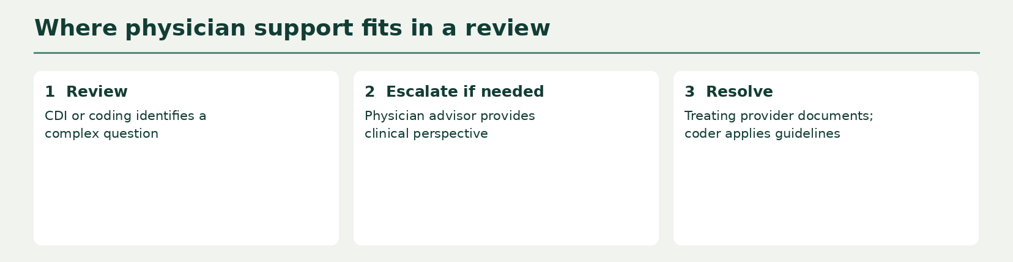
Even experienced CDI specialists and coders encounter cases involving conflicting documentation, unclear clinical indicators, or uncertainty about whether clarification is appropriate. In those circumstances, access to a physician advisor can provide a second clinical perspective. The advisor helps the team evaluate the clinical information and frame the question; the treating provider remains responsible for the patient’s diagnosis and documentation, and the coder applies the applicable coding guidelines.
This support should fit into the hospital’s existing workflow, not create another review layer for every chart. When escalation is appropriate, a focused, compliant query can help the treating provider understand what documentation needs clarification without steering the clinical response. The result is a more informed review process that respects the responsibilities of CDI, coding, physician advisors, and treating clinicians.
For leaders evaluating staffing partners, the question is not simply whether a candidate has relevant experience. It is also what happens when that specialist encounters a difficult case: who can provide clinical guidance, how quickly can the issue be escalated, and how are decisions documented within the hospital’s established processes?
Physician Input When Clinical Questions Get Complex
These illustrative inpatient scenarios show how physician expertise can support CDI and coding teams when a case warrants escalation—not as a required step for every review.
Inpatient Procedure Documentation
An inpatient coder reviewing a vascular operative report sees that blood flow was restored, but the narrative does not clearly describe the objective of each intervention. The distinction may affect how the procedure is classified under ICD-10-PCS. The coder reviews the operative note and coding guidance and identifies a specific documentation question that cannot be resolved from the record alone.
When appropriate under the hospital’s escalation process, a physician advisor can help the coder interpret the clinical sequence and determine whether a neutral clarification request is warranted. The treating surgeon clarifies the procedure performed in the medical record. The coder then assigns the code based on that documentation and the applicable coding rules. Physician input supports the review without replacing either the surgeon’s clinical judgment or the coder’s coding responsibility.
Inpatient Clinical Validation
A CDI specialist reviews a case with a documented diagnosis of acute respiratory failure. The specialist identifies questions about the clinical indicators and whether the documentation consistently reflects the patient’s condition and treatment. Rather than assuming that a diagnosis must be added, removed, or changed, the specialist follows the hospital’s process for evaluating a potential documentation gap.
For a complex or unresolved case, a physician advisor may help evaluate the clinical context and determine whether further clarification is warranted. If a query is appropriate, it should be nonleading and supported by the record. The treating provider documents their independent clinical assessment; the CDI and coding teams proceed based on the resulting record and applicable policies. Not every flagged case requires a query or physician escalation.
The key is a defined decision process. Specialists should know when to continue independently, when to seek physician input, and when to close a review because the documentation does not support further action. Capturing the rationale for complex decisions can also help teams recognize recurring documentation issues and identify opportunities for targeted education.
Turning Recurring Documentation Gaps Into Education
Physician partnership can also help address patterns, not just individual cases. If CDI specialists repeatedly encounter uncertainty about the clinical indicators supporting a diagnosis, or coders repeatedly need clarification about procedural details, those patterns can point to an opportunity for clinician education.

A physician advisor can work with CDI and coding leaders to select representative, appropriately de-identified examples and explain which clinical details would make the documentation clearer. Education should focus on accurate representation of the care delivered, not on encouraging a particular diagnosis or reimbursement outcome. Whenever possible, it should fit existing documentation templates and physician workflows.
Teams can assess whether the education is working by reviewing comparable cases over time: Are the relevant details documented more consistently? Are the same clarification requests occurring less frequently? Measures should account for changes in case mix and review volume. The goal is sustained documentation quality and fewer avoidable interruptions for clinicians.
How Enjoin Supports CDI and Coding Teams

Enjoin Staffing Solutions focuses on more than filling an open role. Our approach pairs qualified CDI and coding professionals with the potential for physician-supported clinical guidance, helping teams navigate complex documentation questions while working within the client’s existing systems and processes. The availability and scope of physician advisor support should be confirmed for each engagement rather than assumed to be identical across all placements.
At onboarding, the hospital and staffing partner should establish clear expectations: which questions warrant escalation, how physician advisors are engaged, who may issue or review a query, and when the organization’s physician champion or compliance team should be involved. Those boundaries help make clinical support useful, timely, and consistent with organizational policy.
Three Questions to Ask a CDI Staffing Partner
1. What clinical expertise supports the specialist?
Ask what happens when a reviewer encounters a complex clinical question. Is physician advisor support available under the engagement? What is the escalation route, what information should be provided, and how is the guidance recorded? The answer should describe a practical workflow rather than make a general promise about access.
2. Who owns documentation and coding decisions?
Confirm who identifies documentation gaps, who evaluates the need for a compliant query, and who sends that query through the organization’s approved process. The treating provider owns clinical documentation and judgment; the coder applies the appropriate coding conventions and rules. Physician advisors provide clinical support without overriding either role.
3. How does the partner improve consistency over time?
Ask how recurring documentation questions are identified and shared with CDI, coding, and physician leaders. A useful partner can help connect chart-level observations to focused education and then evaluate whether those efforts reduce repeat questions and improve documentation clarity.
The next time a specialist encounters a challenging chart, the right staffing partner should offer more than a qualified resume. It should provide a clear path to the expertise needed to work through the question—within your team’s workflow and with clinical responsibilities clearly defined.
Explore Enjoin Staffing Solutions
Selected Guidance for Clinical and Coding Review
CMS ICD-10-CM and ICD-10-PCS Official Guidelines for Coding and Reporting (use the guidelines applicable to the date of service).
ACDIS/AHIMA guidance on compliant clinical documentation queries and organizational query policies.