


The Art of the Denial Appeal: Why Clinical Knowledge Alone Is No Longer Enough

By: Kim Conner BSN, CCDS, CCDS-O, Senior CDI Consultant and Denials Program Manager
Kim Conner is a denial management and clinical appeals expert with deep experience helping healthcare organizations navigate complex payer challenges. Her work focuses on strengthening appeal strategies, improving clinical defensibility, and helping teams translate medical documentation into clear, payer-facing narratives that support appropriate reimbursement. Through her expertise in denial trends, appeal development, and revenue integrity, Kim helps health systems move beyond case-by-case recovery toward stronger, more sustainable denial prevention strategies.
Healthcare denials are no longer just about coding accuracy
Today’s revenue cycle teams are increasingly facing denials tied to medical necessity, clinical validation, severity of illness, inpatient level of care, and retrospective challenges to physician judgment. Payers are no longer simply questioning whether documentation supports a billed code. They are questioning the clinical reasoning behind the care itself.
As denial complexity grows, many healthcare organizations have expanded the role of Clinical Documentation Integrity (CDI) professionals into denial management and appeals. On paper, the transition makes sense. CDI specialists understand clinical medicine, documentation standards, coding guidance, and reimbursement methodologies.
But successful denial appeals require far more than documentation expertise alone.
For health systems, this shift creates a new kind of pressure. Teams are no longer just defending what was documented. They are defending why care was medically necessary, why the physician’s judgment was reasonable, and why the clinical picture supported the level of care at the time decisions were made.
| Traditional Denials | Today’s Clinical Denials |
|---|---|
| Focused primarily on coding accuracy | Challenge medical necessity, clinical validation, and level of care |
| Often resolved through coding guidance | Require clinical reasoning and payer-facing narrative development |
| Centered on what was documented | Question why care decisions were clinically reasonable |
| Managed case by case | Require trend analysis, escalation pathways, and prevention strategy |
| Primarily technical | Increasingly strategic, clinical, and operational |
Denial Appeals Require a Different Skill Set
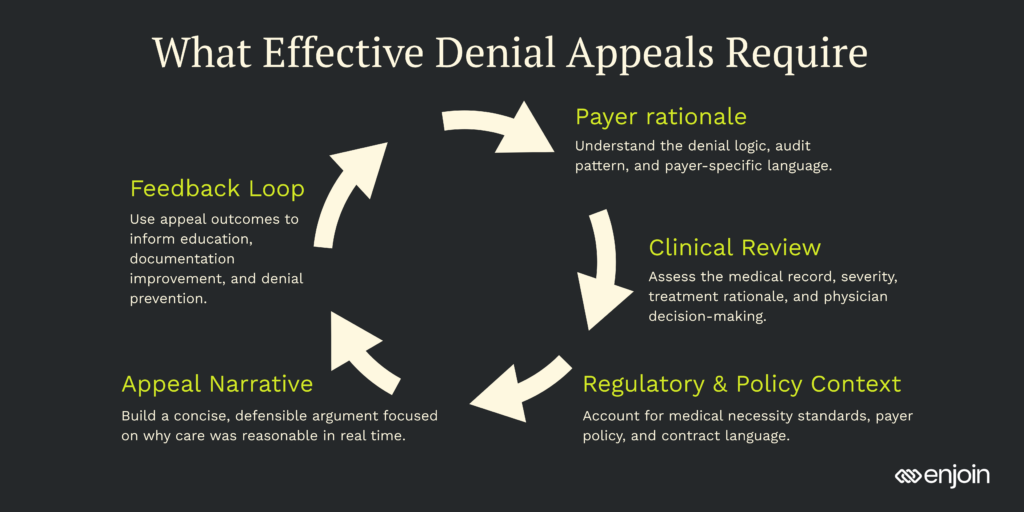
Many organizations assume strong clinical and coding knowledge automatically translates into effective appeal writing. In reality, denial appeals have become a highly specialized discipline requiring strategic communication, payer insight, regulatory understanding, and advanced clinical argument development.
An effective appeal is not simply a summary of the medical record or a list of coding references.
Today’s denial teams must understand:
- Payer rationale and audit trends
- Medical necessity review standards
- Retrospective payer reinterpretation tactics
- Clinical narrative development
- Regulatory vulnerabilities
- Payer-specific terminology and escalation strategies
This complexity continues to grow as payers adopt AI-assisted review systems and increasingly sophisticated audit workflows.
As a result, successful appeals depend less on coding defense alone and more on the ability to clearly explain why physician decision-making was medically reasonable at the time care was delivered.
Why Many CDI Teams Are Struggling
Many CDI professionals are being asked to manage denials without formal training in payer dispute strategy or clinical argument development.
At the same time, they are often balancing concurrent reviews, physician queries, quality initiatives, and productivity expectations. The result can be inconsistent appeal outcomes, staff burnout, and significant reimbursement risk for organizations.
In many organizations, denial work is added to already full CDI workloads without a clear change in staffing, education, workflows, or performance expectations. Teams may be expected to review complex denials, interpret payer rationale, draft appeals, identify trends, and support prevention efforts while still maintaining concurrent review productivity.
Without defined processes and escalation pathways, appeal quality can become highly dependent on individual experience rather than a consistent organizational strategy.
The issue is not a lack of clinical expertise.
The issue is that denial appeal writing requires organizations to combine clinical reasoning, strategic communication, and payer-facing narrative development. These are skills that many teams were never formally trained to build.
Effective Appeals Tell the Patient’s Clinical Story
Successful appeals are rarely won by quoting coding guidelines or listing laboratory values.
They are won by clearly explaining the patient’s evolving condition, the physician’s diagnostic reasoning, the medical complexity involved, and the treatment decisions made based on the information available during the encounter.
That distinction matters.
Strong appeals avoid sounding defensive or overly academic. Instead, they present a concise, payer-focused narrative that demonstrates why the care provided met medical necessity standards in real time and not through retrospective reinterpretation.
What Denial Teams Need to Succeed
Clear Appeal Workflows
Teams need defined processes for case intake, prioritization, physician advisor escalation, appeal drafting, review, submission, and outcome tracking.
Payer-Specific Appeal Strategy
Appeals should account for payer behavior, denial rationale, contract language, clinical review standards, and recurring audit patterns.
Physician Advisor Collaboration
Physician advisors should not only review isolated cases. They should help educate teams, identify trends, and strengthen clinical arguments across denial categories.
Outcome Tracking and Feedback Loops
Appeal outcomes should feed back into CDI education, physician documentation improvement, payer strategy, and denial prevention.
Why Physician Advisors Are Becoming Essential
As denial scrutiny evolves, physician advisors are becoming increasingly important partners within denial management operations.
Historically focused on utilization management and peer-to-peer reviews, physician advisors now play a broader strategic role by helping organizations bridge the gap between bedside medicine and payer expectations.
Their value extends beyond individual case reviews.
Physician advisors help:
- Translate physician decision-making into defensible clinical narratives
- Educate CDI and denial teams on evolving clinical standards
- Support medical necessity and clinical validation defense
- Identify recurring payer vulnerabilities and denial trends
- Strengthen alignment between CDI, coding, utilization review, and revenue integrity teams
Most importantly, they help teach the art of clinical argument development.
Organizations that integrate physician advisors into denial management strategies often strengthen not only appeal outcomes, but also physician education, documentation practices, interdisciplinary collaboration, and long-term denial prevention efforts.
When physician advisors are involved consistently, denial management becomes more than a case-by-case recovery function. It becomes a source of intelligence for the broader organization.
Patterns in medical necessity denials, clinical validation challenges, and payer-specific audit behavior can inform physician education, documentation priorities, utilization review processes, and even payer escalation strategy.
The Future of Denial Management
Today’s healthcare denials are less about whether a code was assigned correctly and more about how payers retrospectively interpret clinical judgment and medical necessity.
As CDI roles continue expanding into denial and appeal work, healthcare organizations must recognize that effective appeal writing is not an automatic extension of documentation review. It is a specialized discipline that requires strategic infrastructure, physician collaboration, payer expertise, and targeted education.
The question is no longer whether CDI professionals should be involved in denials.
The question is whether organizations are providing the support, training, and physician advisor partnership necessary for denial teams to succeed in today’s increasingly complex payer environment.
—
Enjoin combines clinically intelligent technology, advanced analytics, and physician-directed expertise to help health systems improve documentation accuracy, strengthen reimbursement integrity, and reduce denials at scale. With more than $2 billion in identified revenue opportunity and a denial rate below 2% on reviewed cases, Enjoin has mastered a scalable model built to navigate increasing payer scrutiny and documentation complexity. Enjoin’s precision technology, powered by deterministic clinical logic and clinically validated pathways, identifies defensible opportunities before they are reviewed by physician and analyst teams. Learn more about Enjoin’s Denial Defense solution here.