


AI in Clinical Documentation: Where Automation Helps (and Where It Falls Short)
If your health system has evaluated an AI CDI tool in the past year, you’ve likely encountered the same pitch: full chart coverage, automated gap detection, clarification language drafted before the CDI specialist finishes morning rounds. Some of those capabilities are genuine. Others merely describe what a system can flag. Whether those flags are clinically supportable is a separate question with real consequences for reimbursement accuracy, compliance, and documentation quality over time.
This article covers:
- What AI CDI tools do well across inpatient documentation workflows
- Where automation falls short
- Why sustainable documentation improvement requires physician relationships
- What a clinically grounded, technology-supported CDI model produces in practice
AI in Clinical Documentation: Workflow Stages, AI Contributions, and Where Clinical Judgment Is Required
| CDI Workflow Stage | AI Tool Contribution | Where Physician/CDI Expertise Is Required | Risk When Clinical Oversight Is Absent |
| Real-time documentation prompts | Flags missing specificity at the point of care: laterality, acuity, causal relationships | Determining whether a prompt reflects the patient’s actual clinical status | Unsupported diagnoses enter the medical record |
| Chart prioritization and volume triage | Identifies highest-impact documentation gaps across full discharge volume | Evaluating which flagged cases are clinically appropriate to act on | Low-value cases consume CDI capacity; high-value cases go unreviewed |
| Physician query initiation | Drafts compliant clarification language based on identified documentation gaps | Deciding when a request is clinically appropriate, necessary, and non-leading | Non-compliant or unsupported requests create compliance exposure and damage physician trust |
| Clinical validation | Surfaces secondary diagnoses, comorbidities, and potential DRG impact | Confirming that diagnoses are clinically supported and defensible under audit | Overcoding or undercoding with accumulating audit liability |
| Provider education and feedback | Aggregates documentation patterns and provider performance metrics | Delivering peer-to-peer feedback that changes physician documentation behavior over time | Documentation gaps recur; program gains do not compound |
Where AI CDI Tools Add Genuine Value

Over the past few years, AI CDI tools have made meaningful inroads when it comes to scale and prioritization. Traditional programs were built to review a fraction of total discharge volume, concentrating on high-dollar DRGs where the revenue impact justified the labor cost. AI changes that calculus; systems can now scan 100% of discharges for documentation gaps, flagging specificity issues that would otherwise go unreviewed.
The performance data is notable when AI CDI tools operate alongside clinical oversight. Some AI CDI tools report improving MCC/CC capture rates by 15 to 25%, reducing physician query volume by up to 40%, and increasing case mix index by as much as 10%. [1] Those results reflect AI working in its strongest use cases: scanning large data sets for patterns, surfacing opportunities for documentation specificity, and drafting clarification language that CDI specialists and physician advisors then evaluate.
AI’s contribution to clinical documentation is best understood as acceleration. It narrows the review queue and surfaces opportunities; clinical expertise determines which ones move forward and how.
Where Artificial Intelligence Clinical Documentation Falls Short

AI documentation tools are trained to recognize patterns in structured and unstructured clinical data, but it’s still difficult or impossible for them to independently extrapolate what those patterns mean in the context of an individual patient’s full clinical story.
An AI system may flag clinical indicators associated with malnutrition, sepsis, or acute respiratory failure based on lab values and treatment patterns. Whether the documentation actually meets the clinical criteria to support those diagnoses ultimately requires a clinician. An unsupported diagnosis that moves through the workflow just from matching an algorithmic pattern carries both overcoding risk and potential audit liability.
| Scenario | AI Limitation | Clinical Judgment Required |
| Sepsis flagged from lab values | Cannot distinguish systemic infection from localized infection based on documentation alone | Physician to evaluate clinical criteria for sepsis vs. infection with organ dysfunction |
| Secondary diagnosis suggested (e.g., malnutrition) | Cannot confirm whether findings and documentation meet established coding criteria | CDI specialist or physician to validate against clinical and coding standards |
| Clarification language drafted for principal diagnosis | Cannot determine whether the request is clinically appropriate or inadvertently leading | Physician advisor to review for compliance before issuance |
| Documentation gap identified post-discharge | Cannot assess whether a provider amendment is clinically warranted | Clinical reviewer to determine whether a clarification request should be issued at all |
This limitation extends downstream. AHIMA’s guidelines establish that every clarification request must be grounded in specific clinical indicators, whether the language was drafted by a CDI specialist or generated by software. [2] Either way, the compliance obligation remains with the health system. Organizations that have adopted autonomous coding review without clinical validation face the same exposure: unvalidated documentation gaps upstream create coding inaccuracies across the discharge population.
Why Documentation Improvement Requires Provider Relationships

The most durable CDI improvements come from changing how physicians document the complexity and acuity of care they deliver. Identifying gaps in retrospect captures existing errors, but it does not prevent new ones.
Documentation behavior changes when physicians understand why specificity matters and receive feedback from a credible clinical peer. A 2024 study published in The Neurohospitalist evaluated a structured CDI education program for neurology residents and found that 92% rated the curriculum as useful and 96% reported improved understanding of CDI’s role after a single session; improvements in attitudes toward documentation integrity reached statistical significance across multiple measures. [3] Those results came from structured physician-to-physician education.
AHIMA’s guidelines reinforce the same point: clarification requests are insufficient on their own to build documentation integrity at scale. [2] The key to lasting improvement is structured provider education that changes documentation habits. A clinician can explain why documentation specificity matters for care quality, quality metrics, and reimbursement accuracy in a way that creates meaningful long-term change.
What a Clinically Defensible CDI Model Looks Like
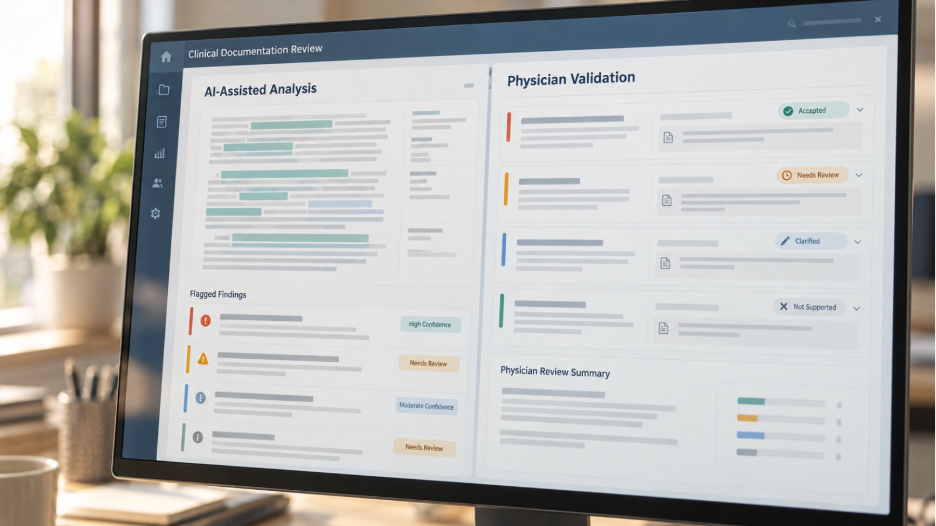
Enjoin’s approach pairs technology with [physician-directed review] at every stage. Our EnFORM+ platform analyzes 100% of post-discharge charts, surfaces unresolved documentation issues, and prioritizes cases by clinical complexity and revenue significance. Board-certified physician advisors with certified coding and CDI credentials then determine what is clinically sound, compliant, and worth acting on. Validated findings flow directly to targeted education for physicians, CDI specialists, and coders; the knowledge transfer is designed to reduce reliance on external review over time.
Across more than five million reviewed charts, our model has contributed to $2 billion in revenue recovery and $400 million in revenue protection, with an average 900% return on investment for health system clients. Pre-Bill Chart Reviews supported by physician validation results in 17 times fewer denied claims, and our clinical education team has delivered more than 10,000 hours of physician-led instruction. When denials do occur, physician advisors provide appeal support based on the same clinical standards payers and auditors apply.
Technology-enabled scale, physician-led validation, and structured provider education are what distinguishes a documentation program built for the long term from one built around automation. Health systems that recognize that boundary are the ones building programs with results that compound.
Connect with Enjoin to schedule a CDI consultation
Frequently Asked Questions
How does documentation quality affect quality metrics beyond reimbursement?
Clinical documentation shapes more than DRG assignment. Mortality index, readmission rates, severity of illness scores, and risk-of-mortality assessments all derive from diagnosis specificity in the medical record. Incomplete documentation yields a falsely low expected mortality baseline, which can inflate a health system’s mortality index, affecting performance benchmarks, specialty rankings, and value-based care outcomes independent of the quality of care actually delivered. [3]
How do AI CDI tools affect query volume, and when is lower volume a concern?
AI CDI tools commonly report reducing physician query volume by 30 to 40%. Fewer clarification requests can be a positive indicator when the reduction reflects improved documentation specificity at the point of care. When technology misses requests a CDI specialist or physician advisor would have recognized, lower volume reflects missed opportunities, not program success.
How does Enjoin’s education component work in practice?
Enjoin’s Physician-Led Education & Advisory delivers direct peer feedback from board-certified advisors to attending clinicians, alongside targeted coaching for CDI specialists and coders. Guidance is drawn from actual chart reviews, ensuring it is specific and actionable. The aim is to improve how care complexity and acuity are documented, so that the same gaps won’t recur across the next discharge population.
Last updated: October 14, 2026
Sources
[1] Elion. “AI Clinical Documentation Integrity Buyer’s Guide.” June 2025. https://elion.health/resources/ai-clinical-documentation-integrity-buyers-guide
[2] AHIMA/ACDIS. “Guidelines for Achieving a Compliant Query Practice (2022 Update).” https://ahima.org/media/51ufzhgl/20221212_acdis_practice-brief.pdf
[3] Aghajan Y, Molyneaux BJ. “Curriculum Innovation: Clinical Documentation Integrity Education for Neurology Trainees.” The Neurohospitalist. December 2024. https://pmc.ncbi.nlm.nih.gov/articles/PMC11638927/